
Chemical compliance, from safety data sheet to filed report.
Chemsana reads your safety data sheets, totals every chemical across your sites by CAS number, and checks new chemicals against federal thresholds and your permits before they arrive. Employees reach SDSs by QR code, and Tier II, §311, and release reports come from the same data.
Most sites start with a 30-day pilot at one facility.
How Chemsana works
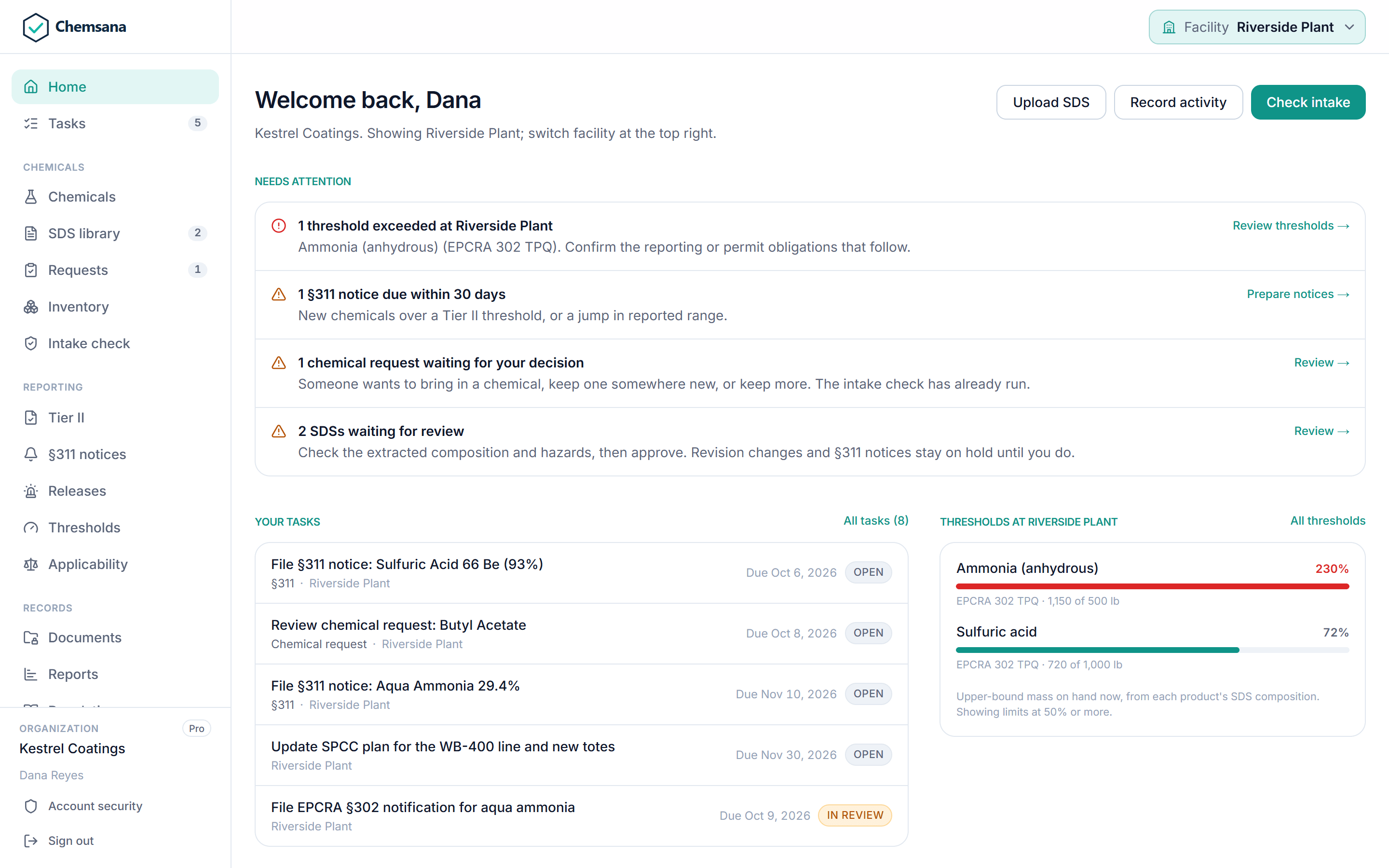
Chemsana connects three things most sites keep in separate places: what each product contains, how much of it is on site, and which regulations apply at what threshold. The result is a decision you can defend, before a chemical is bought, stored, or used.
Read the SDS
Extract composition, hazards, and properties. Score confidence. Check against the PDF and lock.
Track inventory
A ledger of receipts, uses, and moves by location, from forms, CSV, API, or a certified count.
Decide
Screen a proposed receipt against federal lists and site permits, or route it as an approval request.
File and prove
Tier II, §311 notices, release notifications, and a defensibility package from the same data.
Why aggregation is the whole problem
Thresholds apply to the total of a chemical across the entire site, not to any one product. A solvent at 30% in one drum and 12% in a tote are the same CAS number to the regulator. Chemsana does that math continuously, so nobody has to rebuild it in a spreadsheet at filing time.
One system for the whole chemical program
From the storeroom shelf to the state portal, each part works from the same records.
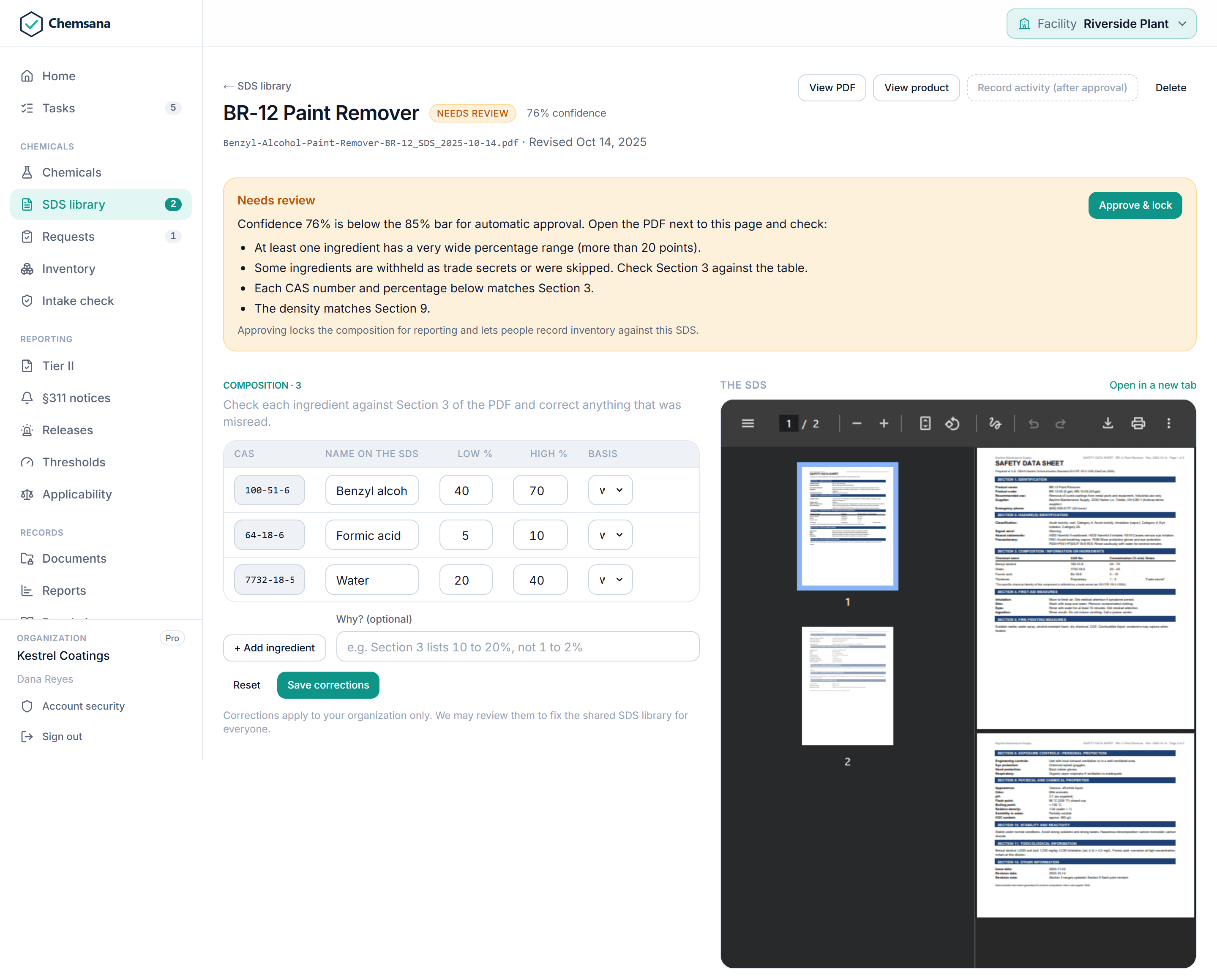
From a PDF to a verified composition
CAS numbers, concentration ranges, GHS hazards, density, flash point, and pH extracted from each SDS. Every extraction is scored, and low-confidence results go to a reviewer with the PDF alongside.
SDS ingestion Workplace access and approvalsBuilt for the people who handle the chemicals
A QR code in each storeroom opens that location’s SDSs and hazard summaries on any phone, with no login. New chemicals are requested, checked, and approved before they are bought.
Access and approvals InventorySite-wide totals at the CAS level
A ledger of receipts, uses, moves, and counts, multiplied through each product’s composition and summed across the site, with low, nominal, and high bounds.
Inventory Regulatory and decision engineA decision before the chemical arrives
Each proposed receipt is screened against 3,908 federal rules and your own permits: Allowed, Flag, or Block, with the citation, threshold, and projected total shown.
Decisions Filing and reportingFilings built from the data you already keep
Tier II reports with EPA form, Tier2 Submit, and XML exports. §311 notices with deadline reminders. Release screening against CERCLA and EHS reportable quantities.
Filing Thresholds and fire codeEvery limit, measured the way its rule measures
Facility, process, annual-use, and release thresholds each in their own scope, plus IFC maximum allowable quantities by control area.
ThresholdsThe principles the engine is built on
| Principle | What it means in practice |
|---|---|
| AI reads, rules decide | A language model extracts data from the SDS. It never decides regulatory applicability. Every verdict comes from deterministic rules, with the math shown. |
| Conservative by default | SDS concentration ranges are carried as low and high bounds. Threshold checks use the upper bound, so a range never hides an exceedance. |
| No silent negatives | The engine only reports “not listed” for a program whose list is fully loaded. Anything it could not screen is labeled a gap, never a clearance. |
| Assumptions travel with the answer | Default densities, wide ranges, unverified CAS numbers, and unreviewed compositions are tagged on the decision itself. |
| Recorded as made | Every evaluation is stored with its inputs, rules, and explanation. A report reprinted years later shows the original result. |
What your team works in every day
Screens from the product as it ships today, shown with demonstration data.
Extraction you can check
Each extraction gets a confidence score built from the checks a reviewer would run by hand: valid CAS checksums, compositions that can sum to 100%, plausible density, no withheld components.
- 0.85 and above is approved automatically, and recorded as a system approval
- Lower scores go to a review queue ranked by consequence
- Approval locks the composition and records who approved it
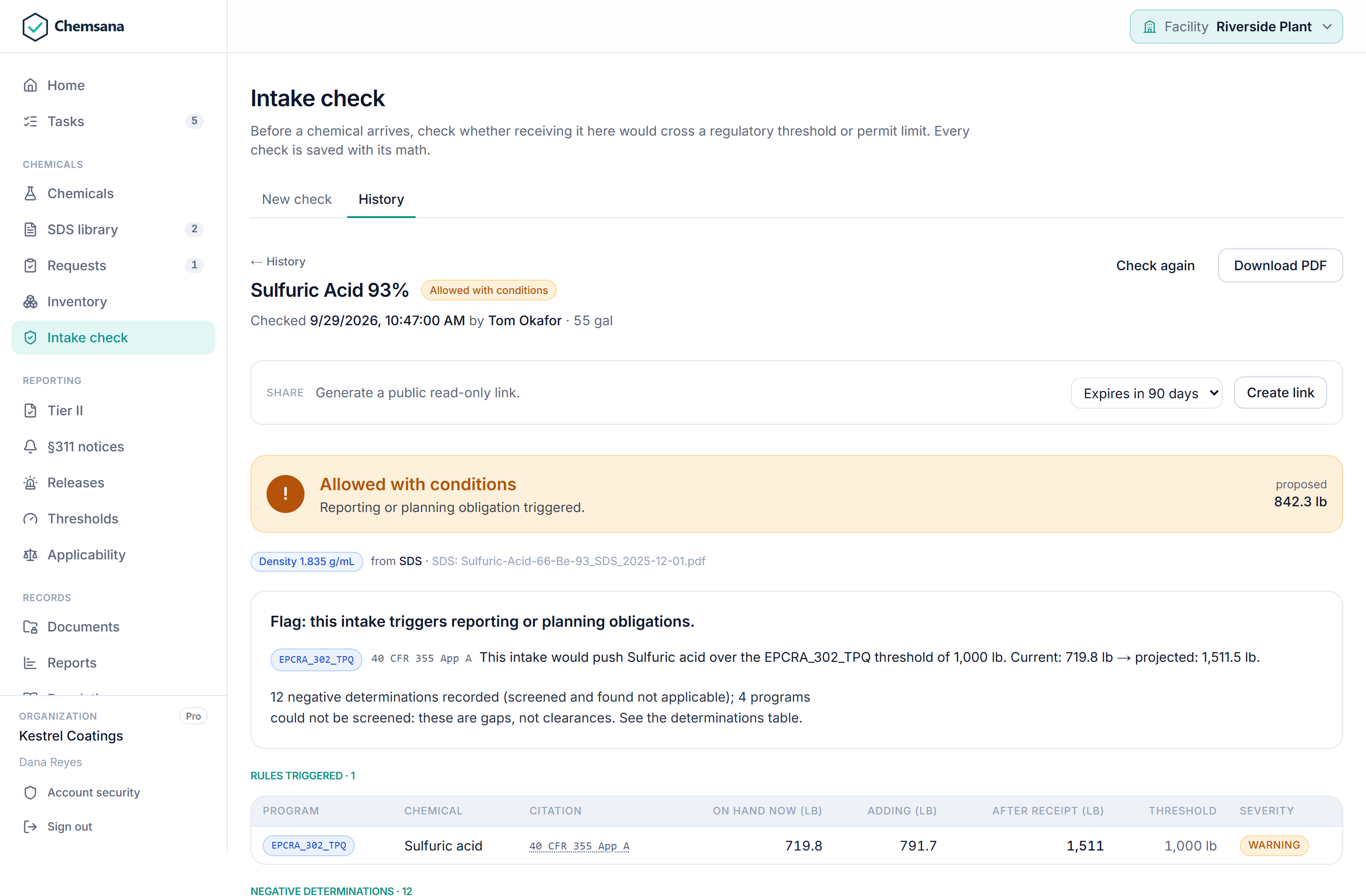
The math, the citation, and the gaps
Every triggered rule shows its program, citation, threshold, current mass, added mass, and projected total. Clear results are recorded too, with the list version they were checked against.
- Allowed, Flag, or Block
- A program that could not be screened is labeled a gap, not a pass
- Print a one-page report or share it by expiring link
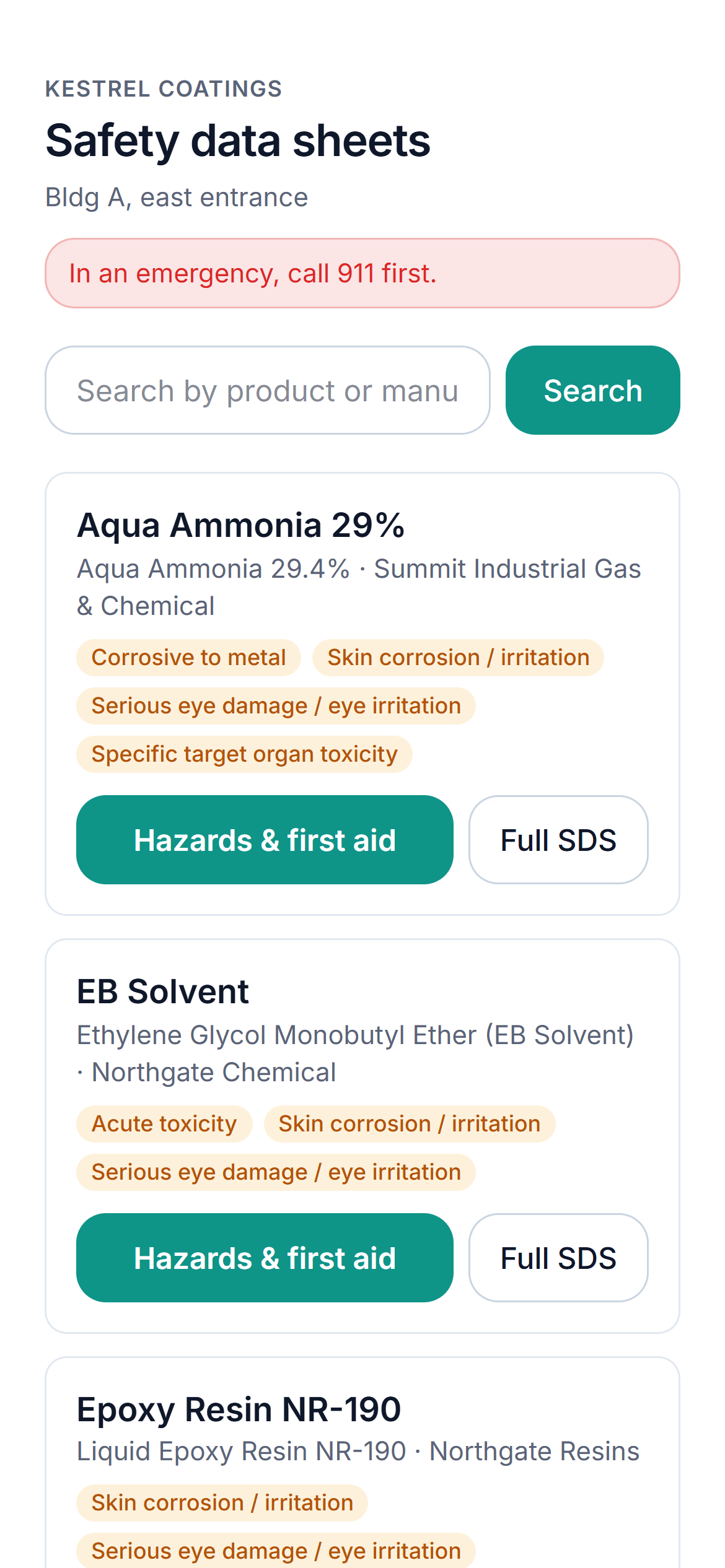
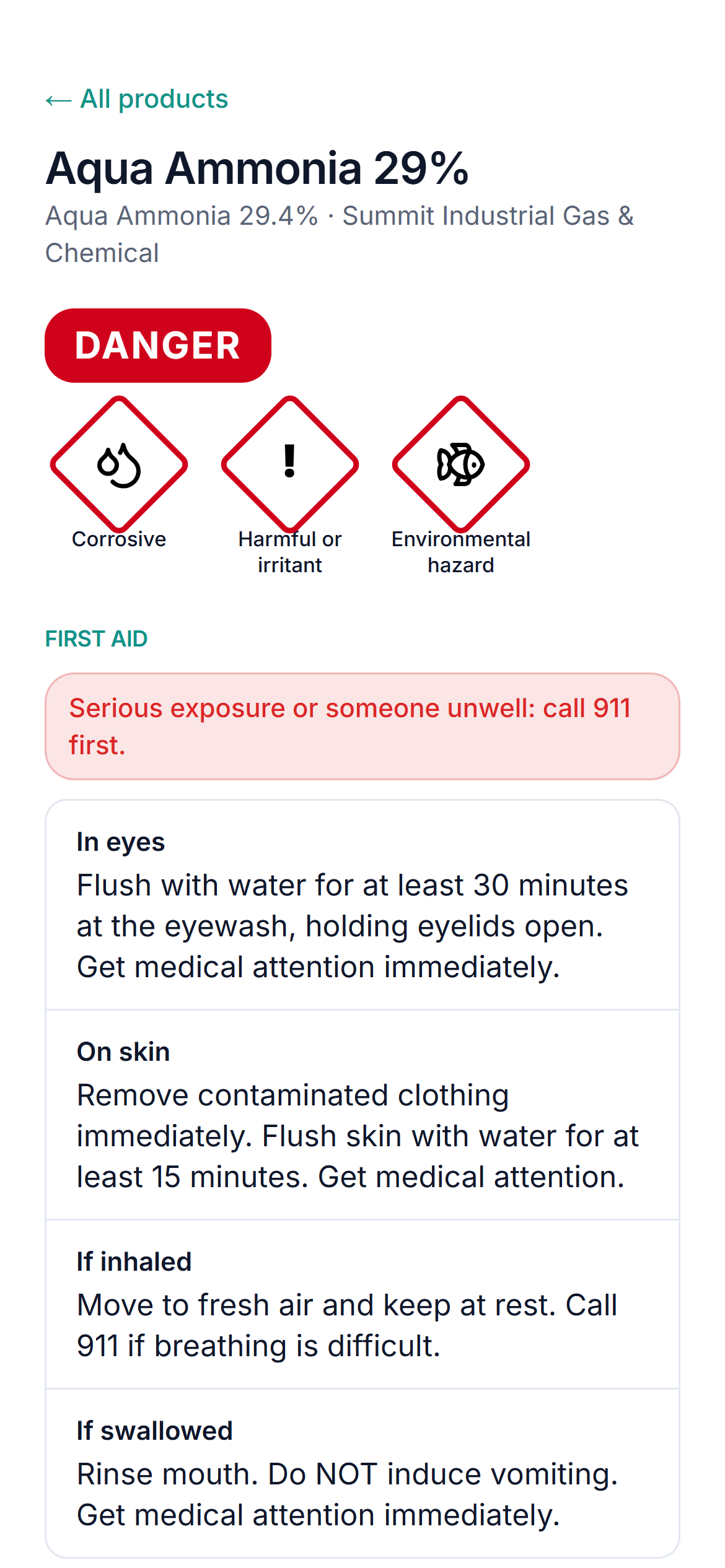
An SDS on any phone, with no login
Print a QR poster for each storeroom, shop, or lab. Scanning it shows only the products stored there, each with a one-screen hazard summary and the full SDS one tap away.
- Signal word, pictograms, first aid by route, fire-fighting, and PPE
- An offline binder PDF for network outages
- Links can be revoked and show when they were last used
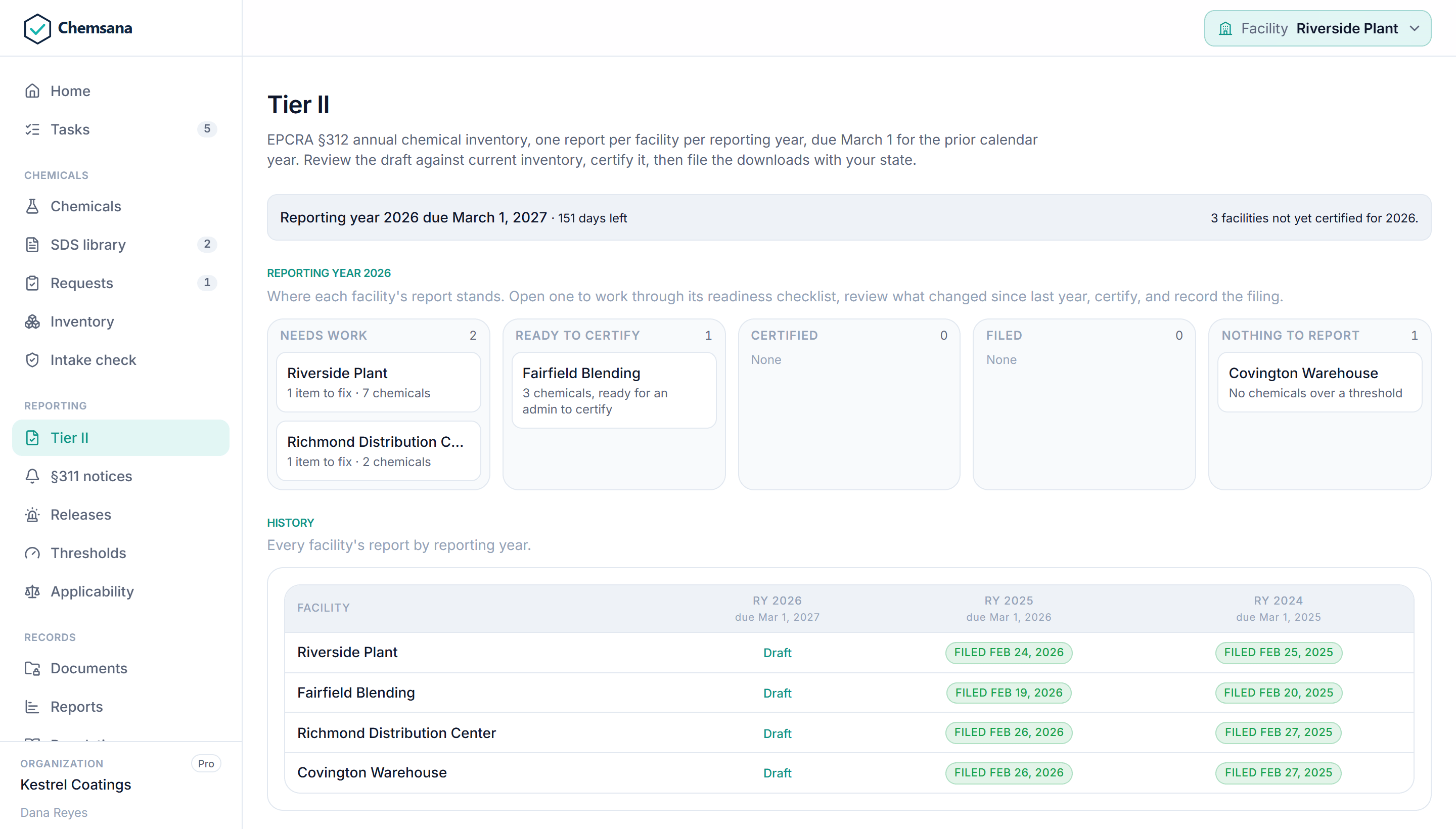
Filing season on one board
Every facility by reporting year: needs work, ready to certify, certified, filed, or nothing to report. Reviewers start from what changed since last year’s certified report.
- EPA form PDF, Tier2 Submit (.t2s), Tier II XML, and a Texas STEERS worksheet
- E-signature with certification text
- Filing date, confirmation number, and fee kept with the report
What we screen against
Federal lists are sourced from the EPA List of Lists. When EPA publishes an update, Chemsana diffs it into a changeset and emails the admins of every affected organization.
| Program | Citation | How it is applied at intake |
|---|---|---|
| EPCRA §302 EHS / TPQ | 40 CFR 355 App. A | Storage threshold. Warns when crossed or already exceeded. |
| CAA §112(r) | 40 CFR 68.130 | Storage threshold. Warns when crossed or already exceeded. |
| OSHA PSM | 29 CFR 1910.119 App. A | Storage threshold, plus facility-level applicability screening. |
| CERCLA RQ | 40 CFR 302.4 | Informational at intake. Applied in release reporting. |
| TRI / EPCRA §313 | 40 CFR 372.25 | Informational, with de minimis and facility applicability screening. |
| RCRA P and U lists | 40 CFR 261.33 | Informational. Counts toward generator status. |
| RCRA D001 / D002 | 40 CFR 261.21, 261.22 | Computed from SDS flash point and pH. |
| Your site permits | Air, water, waste | Named chemicals set to flag or block, with an optional limit. |
A clear answer, including when the answer is “we could not check”
Chemsana records negative determinations too: below threshold, not listed, de minimis, exempt, or facility not subject, each with the list version it was checked against. A program that could not be screened shows as a gap. An inspector asking “how do you know this isn’t reportable?” gets a documented answer.
Built for the teams who own chemical risk
EHS and compliance managers
Site-wide totals, Tier II and §311 filings, and a documented answer for every chemical on site.
Plant and operations leads
Request a chemical, a new location, or more quantity, and get approved, approved with conditions, or declined with a reason.
Environmental consultants
One system of record across client sites, with switching between organizations and a defensibility package per facility.
A 30-day pilot at one site
Load the SDS library, import current inventory, post QR codes in the storerooms, and run your next few purchases through approval requests. By the end you have a working Tier II draft and a clear view of where your thresholds sit.